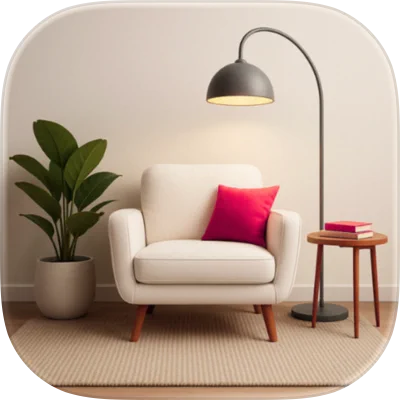
The cool-gray decade is over. Warm colors — terracotta, ochre, sage green, rust, and earthy neutrals — now dominate residential interior design. This guide covers the four main warm color families, how they work individually and in combination, and how to apply them in every room of your home.
Terracotta & Clay
The color that defined the decade
Terracotta
Fired clay
Raw sienna
Warm cream
Terracotta — literally 'baked earth' in Italian — is the defining warm color of the current interior design moment. It has the warmth of red without the aggression, the earthiness of brown without the heaviness. In its natural, slightly muted form (think the inside of an unglazed pot rather than a traffic cone), it works in almost any room and against almost any natural material.
In practice, terracotta appears most successfully as a wall color in living rooms and bedrooms, as upholstery fabric in statement chairs or sofas, as flooring tile in kitchens and entryways, and as ceramic accents on shelving. It pairs naturally with warm cream, olive green, aged brass, and natural wood — all the elements of the current design moment.
The key to terracotta that works is saturation. A washed-out, too-light terracotta reads as salmon or dusty pink. A too-saturated one reads as burnt orange. The sweet spot is a mid-tone that has warmth and depth without the rawness of red.
Practical tip
Use terracotta on a north-facing wall with caution — it can read as quite cold and brownish in rooms that receive no direct sun. South and east-facing rooms amplify terracotta beautifully.
Ochre & Mustard Yellow
The warmest accent in the warm palette
Ochre
Mustard yellow
Harvest gold
Warm cream
Ochre and mustard yellow occupy a specific role in the warm palette: they are the most energetic warm tones, providing visual lift without the full intensity of orange or red. At the right saturation, mustard yellow reads as sophisticated and considered — the favorite color of mid-century modern designers and now returning to prominence as the 70s revival continues.
The distinction between good and bad mustard is saturation and undertone. A blue-based mustard reads as neon and challenging; a red-based mustard reads as harvest gold and autumnal. The most successful interior mustards have a warm brown or orange undertone that ties them to the earth-tone palette rather than pulling toward primary yellow.
Mustard works best as an accent rather than a dominant: a velvet mustard armchair against warm white walls, mustard linen cushions on a grey sofa, a mustard abstract print above a natural wood sideboard. In rooms with strong natural light and warm wood tones, it can be used more extensively.
Practical tip
Test mustard in your specific lighting before committing — it is one of the most lighting-sensitive colors in the warm palette. Daylight makes it richer; artificial light can push it toward orange.
Sage Green & Olive
The cool side of the warm palette
Sage green
Olive green
Warm green
Warm cream
Sage and olive are greens with a warm yellow base — which places them firmly in the warm color family despite being green. They function as the neutralising partner to terracotta and ochre, providing enough visual separation from the hot end of the palette to prevent a room from feeling unrelenting.
The sage-green moment has been sustained by the natural materials trend — sage connects visually to plants, herbs, and the outdoors. It works particularly well as a wall color in kitchens (a sage green kitchen with brass hardware is one of the defining looks of the early 2020s), in bedrooms (restful without being cold), and in bathrooms (the botanical wellness aesthetic).
Olive is richer and more saturated than sage — it reads as more masculine and more serious. It functions well as a statement color in living rooms and studies, particularly when paired with warm cream, aged leather, and natural wood. Unlike sage, which works in many contexts, olive benefits from confident, deliberate application.
Practical tip
Sage green pairs with almost everything in the warm palette — terracotta, warm white, natural wood, brass, mustard, and rust. If you are unsure where to start with warm colors, sage is the lowest-risk entry point.
Warm Neutrals
The foundation of the warm color room
Warm white
Warm beige
Greige
Warm cream
Warm neutrals — warm white, warm beige, greige (gray-beige), camel, cream, and sand — are the foundation that makes the rest of the warm palette work. They are not the background against which colors appear; they are the primary color of most of the room, with warmer accents as the secondary and tertiary layers. Get the neutral wrong and everything built on top of it will feel disconnected.
The critical distinction is undertone. 'White' is not white — every white paint has an undertone: blue, green, pink, or yellow-orange. A warm white has a yellow or red undertone; it reads as cream or ivory in strong light. A cool white has a blue undertone and will fight against every warm color you add to the room. When building a warm palette, choose a white with an explicitly warm undertone.
Greige is the most versatile neutral in the warm family — it reads as gray in strong light, beige in warm/dim light, and it bridges the two families seamlessly. It works in open-plan spaces where you need a single neutral that will read differently across zones with different lighting conditions.
Practical tip
Always test paint on the actual wall in the actual lighting conditions before committing. Paint chips look different from rolls; rolls look different on the wall; wall color looks different at 9am, 1pm, and 9pm. Live with a large swatch for a week.
Room-by-room warm color guide
See warm colors in your room
The fastest way to know whether a warm color palette works in your specific room — with its particular light, proportions, and existing elements — is to see it. Upload a photo of your room and AI Room Decor will generate redesigned versions in warm-palette styles (Boho, Farmhouse, Japandi, Minimalist) within 10 seconds. Free to try, no credit card required.
Try Free — See Warm Colors in Your Room